

Every engineering team believes in quality. Every team says their test suite protects them.
And yet almost every mature system eventually accumulates something that quietly erodes speed, morale, and confidence: flaky tests.
Not broken tests. Not obvious failures caused by real bugs. Flaky tests. The ones that pass. Then fail. Then pass again. The ones that turn a simple pull request into three CI runs. The ones that make developers sigh and say, “just re-run it.”
If you browse Reddit long enough, you’ll see the same frustration everywhere. We actually went through threads across r/programming, r/softwaretesting, and r/devops to take the pulse. Not because Reddit represents the whole industry, but because it’s where engineers speak honestly when something isn’t working.
And yes, Reddit skews negative. People don’t start threads saying, “Our test suite is stable and life is good.” They post when a test fails for the third time in CI and blocks their pull request.
In r/QualityAssurance, one user wrote: “Flaky tests are not almost fine. They’re noise.” Noise is the perfect word. Because noise isn’t just annoying. Noise creates confusion. And confusion spreads.
So the real question isn’t whether flaky tests are inconvenient. It’s whether they’ve quietly become a form of organizational debt.
What flaky tests really do to teams
In software testing, a test should give you clarity. It should fail when something is wrong and pass when everything works. That simple contract is what gives teams confidence in their systems.
Flaky tests break that contract.
A flaky test fails without relevant code changes. It fails because of timing issues, race conditions, global state leaking across test runs, external systems responding unpredictably, or a fragile test environment. Sometimes it’s UI tests that depend on rendering speed. Sometimes it’s shared resources in CI pipelines. Sometimes it’s test order dependency where the same test behaves differently depending on what ran before it.
The result is always uncertainty.
When a test fails, you hesitate. Is this a real bug? Is this a genuine failure? Or is this another case of test flakiness?
That hesitation slows everything down. Developers stop trusting test results. Continuous integration loses its sharp feedback loop. The development process becomes reactive instead of confident.
What specialists on Reddit are actually saying
Reddit threads across r/programming, r/softwaretesting, and r/devops often repeat the same story. But it’s worth saying this clearly: Reddit is not a balanced dataset. People don’t usually open a thread to say, “Our test suite is stable and everything works great.” They post when something hurts.
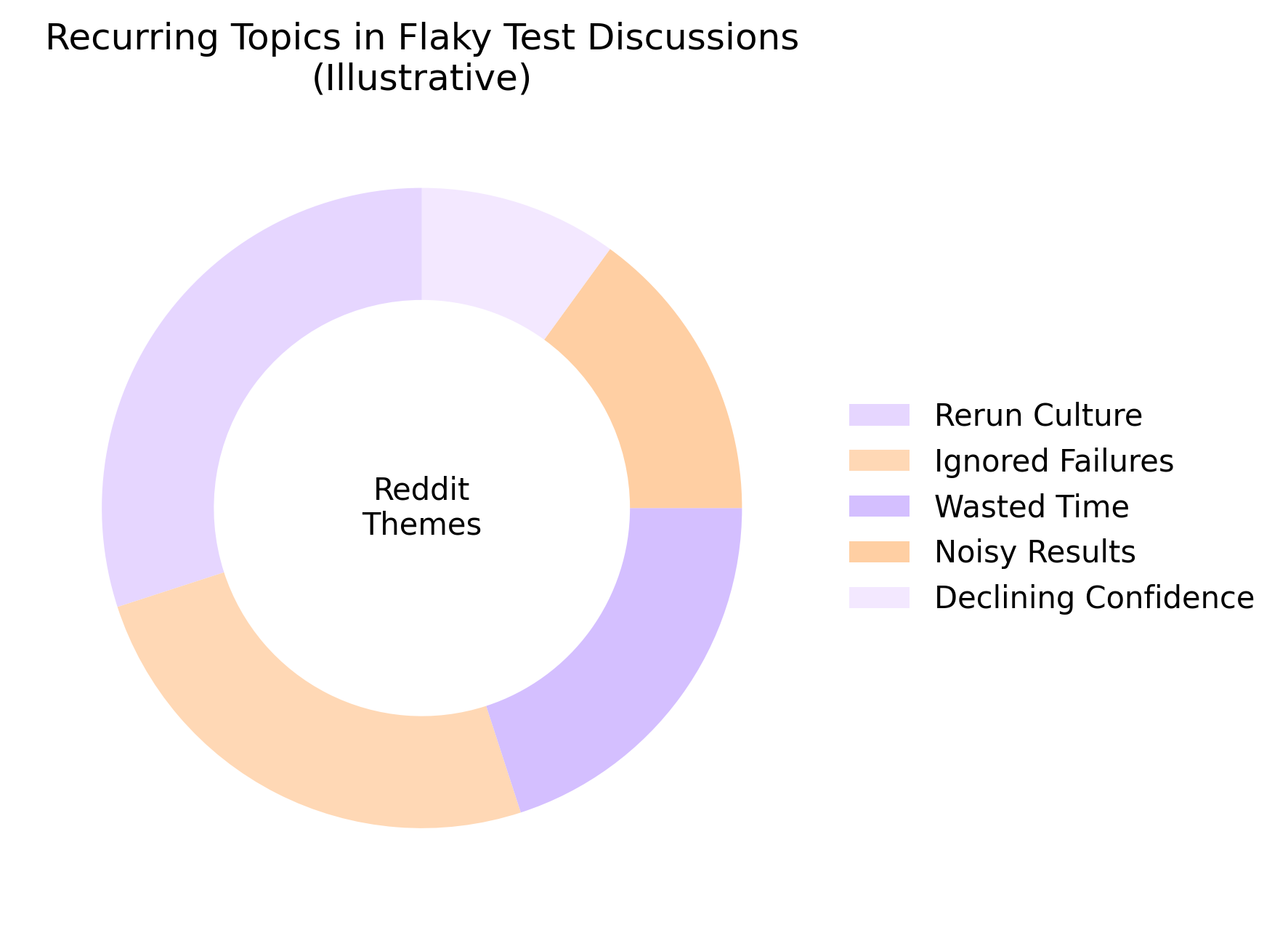
In one discussion about managing flaky tests, engineers describe reruns failed tests scripts in their CI pipelines. The practice becomes normalized. A test fails, it gets a re run automatically, and if it passes the second time, the build is marked green.
On r/devops, another thread highlights how slow CI runs combined with flaky test failures led developers to ignore failed jobs entirely.
If a test fails but passes on the next run, teams start assuming it’s safe. That mindset slowly reshapes behavior. Instead of investigating root cause, the default response becomes: re run, merge, move on.
In r/softwaretesting, practitioners ask how to detect flaky tests at scale and how to determine flakiness without spending half the sprint in analysis mode.
The themes are consistent: wasted time, noisy test results, and declining confidence.
Why flaky tests resemble organizational debt
Technical debt lives in code. Organizational debt lives in behavior.
Flaky tests sit at the intersection of both.
At first, a flaky test feels minor. It fails occasionally. Someone reruns it. It passes. The team moves on.
But over time, patterns form.
Developers begin to expect multiple test runs. CI pipelines grow slower because of repeated executions. Test suites become bloated with tests that don’t reliably run independently. Test management discussions shift from improving coverage to debating whether failures are real.
Eventually, every test failure requires analysis. Teams dig through logs, compare test data across CI runs, inspect external dependencies, and try to identify patterns in flakiness. That effort consumes time that could have been spent improving systems or fixing real bugs.
This is how flaky tests become debt. Not because they exist, but because they are tolerated.
How flaky tests affect test management
Strong test management relies on clarity. You need to know whether a test fails because of code changes or because of unstable systems.
When flakiness increases, test management becomes defensive. Teams create quarantine lists. They rerun failed tests. They add retries to CI pipelines. They exclude flaky test failures from metrics.
These coping mechanisms reduce short-term pain but increase long-term debt.
Instead of addressing flaky test detection systematically, teams patch around symptoms. Instead of identifying root cause, they normalize noise.
In many cases, flaky test detection is manual. Someone notices that a test fails intermittently across multiple test runs. Someone tries to identify flakiness by scanning historical data. But without proper detection systems, patterns remain hidden.
Over time, developers lose confidence in automated tests. They hesitate to rely on test results when reviewing a pull request. That hesitation weakens continuous integration and continuous delivery.
Common causes engineers keep mentioning
Across Reddit discussions, certain common causes appear repeatedly.
Race conditions are a major one. Asynchronous systems interacting unpredictably can cause test failures that are difficult to reproduce locally.
Global state and test order issues also surface frequently. When tests don’t run independently, hidden dependencies between tests introduce flakiness. A test that passes alone may fail when executed after other tests because shared state wasn’t reset properly.
External systems and external services are another source of instability. If tests depend on APIs, third party systems, or network calls, variability creeps in. Without proper control of external dependencies, test flakiness increases.
And then there’s slow, brittle UI tests. UI tests often interact with rendering delays, animations, and browser differences. When not designed carefully, they become a hotspot for flaky test failures.
None of these causes are surprising. What’s surprising is how often teams accept them.
Why reruns are not the solution
Multiple test runs can help identify patterns. But automatic reruns in CI pipelines should support flaky test detection, not replace it.
If a test fails on the first run and passes on the second, you still have flakiness. The re run only masks detection.
When reruns failed tests becomes standard practice, teams stop asking how flaky tests appeared in the first place. They stop investigating how flaky tests reflect weaknesses in their systems, test environment, or development process.
Eventually, the culture shifts from “fix it” to “work around it.”
That shift is organizational debt.
Detection is the turning point
The difference between manageable flakiness and organizational debt lies in detection and discipline.
Flaky test detection requires data. You need visibility into test results across CI runs. You need to determine flakiness statistically, not emotionally. You need to identify patterns across test suites, across code changes, across environments.
Without structured detection systems, teams rely on anecdotal evidence. Developers say, “this test is flaky.” But no one can measure how often it fails, under what conditions, or whether flakiness correlates with external systems or specific code paths.
Good test detection practices allow teams to separate flaky test failures from genuine failures. They restore clarity. They rebuild confidence.
And once you can detect flaky tests reliably, you can fix flaky tests deliberately instead of reactively.
The behavioral impact of flaky tests
Perhaps the biggest cost is psychological. When test failures feel unreliable, developers start assuming that failed tests are harmless. They stop seeing them as signals. They see them as obstacles.
That mindset spreads. Code gets merged after “green enough” CI pipelines. Teams prioritize speed over certainty. Over time, real bugs hide inside noisy failure logs.
The engineering organization may not even notice the shift until a production incident forces reflection.
At that point, the conversation changes from “how flaky tests appeared” to “why didn’t our systems catch this earlier?”
Are flaky tests inevitable?
Complex systems will always have edge cases. Distributed systems introduce unpredictability. External dependencies are not perfectly stable. Some level of flakiness may be unavoidable.
But inevitability is not the same as acceptance.
Flaky tests only become debt when they are ignored, normalized, or masked.
They become debt when they reduce trust, increase wasted time, and distort testing processes.
They become debt when the default reaction to failure is “re-run” instead of “identify the root cause.”
Frequently asked questions
Why do flaky tests keep failing in CI pipelines but pass locally?
This is probably the most common complaint you’ll see on Reddit. A test fails in CI, triggers failed jobs, everyone panics… then it passes locally. So what’s going on?
Most of the time, the test environment in CI is simply different. CI pipelines run in parallel, under load, sometimes with shared resources. Local machines don’t replicate that perfectly. That difference alone can expose flaky behavior in systems that otherwise “seem fine.”
Another big culprit is order and isolation. If your test suite doesn’t guarantee that each test runs independently, running tests in parallel or in a different sequence can cause a test fails situation even if the underlying code hasn’t changed. Developers often discover that multiple test runs in CI expose timing issues or race conditions that never show up locally.
The fix isn’t just rerunning tests until they pass. It’s looking at the data from CI runs, identifying patterns, and tightening control over how your systems behave under real CI/CD conditions.
How can we identify flaky tests before they destroy confidence?
Reddit threads are full of teams saying, “We know we have flaky tests, but we can’t prove which ones.” That’s usually where flaky test management breaks down.
If a test fails once, that doesn’t automatically make it flaky. But if the same test produces inconsistent results across CI pipelines with no relevant code changes, you’re likely dealing with flaky test results.
The only real way to identify flaky tests is through analysis over time. You need historical test results, multiple CI runs, and visibility into how tests behave across environments. Auto detection helps, especially when your test suite is large and developers don’t have time to manually investigate every failure.
When you systematically identify flaky patterns, you protect confidence. Without that, developers start assuming every failure is noise, and real bugs can slip through because people stop taking failures seriously.
What is the best way to prevent flaky tests in the first place?
Most engineers on Reddit agree on one thing: prevention is easier than constant repair.
If you want to prevent flaky tests, start with isolation. Every test should run independently. No hidden global state. No dependency on execution order. No shared data leaking across runs. Strong unit tests usually behave better than broad integration tests, but even they can turn flaky if they rely on unstable data or poorly controlled systems.
CI/CD also plays a role. CI pipelines expose weaknesses because they stress systems differently than local development. Running tests under realistic conditions earlier in the development process helps catch instability before it spreads.
And honestly, sometimes it comes down to discipline. Writing tests carefully, controlling the test environment, and refusing to normalize multiple test runs as a solution. When developers treat every flaky failure as something worth understanding — not something to ignore — the overall health of the test suite improves.
Flaky behavior doesn’t disappear overnight. But strong flaky test management and better control over systems make a real difference over time.
Conclusion: what you tolerate defines your systems
Flaky tests are not just a testing inconvenience. They are signals.
Signals about fragile systems, insufficient isolation, weak control over external dependencies, and gaps in test management.
If you treat flaky tests as background noise, that noise will grow. It will slow your CI/CD pipelines. It will reduce confidence in automated tests. It will weaken your development process.
But if you treat them as organizational signals, you regain control.
The teams that win are not the ones with zero flakiness. They are the ones that invest in detection, identify patterns early, fix flaky tests consistently, and prevent flaky tests through better system design.
If you want a practical starting point for strengthening your testing processes and regaining confidence in your test results, download our software testing cheatsheet. It breaks down what to watch for, how to structure test management, and how to keep your systems reliable without drowning in flaky noise.


.png&w=3840&q=75)