
.svg)
Engineers and testers are losing confidence in their test pipelines.
Over the past six months, we analyzed Reddit discussions across r/QualityAssurance and r/softwaretesting using a structured sentiment analysis approach. We processed large volumes of unstructured text, classified sentiment as positive, negative, or neutral, and grouped recurring themes using semantic analysis and machine learning models.
One pattern stood out. Negative sentiment is clustering around trust in test results.
Threads about software testing rarely focus on new features or tools. They focus on flaky builds, unreliable environments, retry habits, and the gap between coverage growth and release confidence. Manual testing is still respected. Automation is widely adopted. The problem is not effort. It is signal reliability.
For CTOs, this is not a community mood swing. It is operational data. When engineers stop trusting the feedback loop, release speed slows, risk increases, and user satisfaction becomes harder to predict.
This article breaks down the dominant sentiment patterns and what they indicate about the current state of testing.
Short summary
- In our six-month review, 72% of comments about CI reliability were negative, making flaky pipelines the dominant source of frustration. Trust in test results is the core issue raised across threads.
- When coverage and bug KPIs were discussed, 64% of comments were negative about coverage targets and 59% were negative about defect-count metrics. Practitioners question whether these numbers reflect real release risk.
- Manual testing discussions showed 52% positive sentiment, significantly higher than automation stability threads. Exploratory testing is often described as a confidence layer.
- Threads mentioning automation targets or delivery expectations showed 58% negative sentiment, often tied to scaling volume without stabilizing pipelines.
- Career-related threads showed 55% negative sentiment, with concerns around role clarity and long-term stability in software testing.
What we looked for
We reviewed 29 high-engagement threads posted between August 2025 and January 2026. Each thread contained dozens of comments, resulting in hundreds of individual data points.
We focused on topics that repeatedly surfaced:
- Flaky CI pipelines
- Automation reliability
- Manual testing value
- Test coverage and metrics
- Leadership expectations
- Job market pressure
Examples of threads included in the sample:
We did not cherry-pick extreme takes. We selected threads with strong engagement because they signal broader resonance within the community.
How did we analyze the data?
Reddit comments are unstructured text. To make sense of large volumes of feedback, we used a lightweight sentiment analysis approach.
First, we classified comments as positive, negative, or neutral based on emotional tone and language patterns. This allowed us to identify where negative sentiment was clustering.
Second, we applied aspect-based sentiment analysis. Instead of asking “Is this thread positive or negative overall?”, we asked:
- What is the sentiment around CI stability?
- What is the sentiment around manual testing?
- What is the sentiment around automation maintenance?
- What is the sentiment around leadership decisions?
This helped isolate where frustration was concentrated.
To support consistency, we combined rule-based tagging with simple machine learning models trained to classify text. This is a common approach in natural language processing when analyzing large volumes of user feedback across social media platforms.
The goal was not academic precision. The goal was pattern detection.
Why Reddit?
Reddit functions as raw user feedback at scale. It captures emotional tone that rarely appears in survey responses or customer feedback forms. It reflects how practitioners feel when speaking to peers rather than managers.
For engineering leaders, this kind of sentiment analysis is important because it surfaces early signals. Negative sentiment around testing pipelines is rarely about one tool. It often reflects deeper challenges in development process, data stability, ownership, and release confidence.
The following sections break down those sentiment clusters and what they indicate for CTOs and engineering leadership.
Flaky pipelines are the dominant source of negative sentiment
When we ran our sentiment analysis across six months of Reddit discussions, one cluster stood out immediately: CI instability.
Using a hybrid approach that combined a rule based approach with lightweight machine learning, we analyzed hundreds of comments and classified sentiment as positive negative or neutral. We also applied aspect-based sentiment analysis to separate discussions about pipelines, coverage, manual testing, and leadership.
The result was consistent.
Around 72% of comments referencing CI reliability carried negative sentiment. Specialists repeatedly used words like flaky, unstable, inconsistent, retry, and unreliable. Neutral sentiment appeared mostly in troubleshooting threads. Positive sentiment was rare.
What stands out in the textual data is not frustration with a specific tool. It is frustration with signal reliability. The testing professionals describe losing trust in their pipelines. They talk about disabling unstable tests just to restore flow.
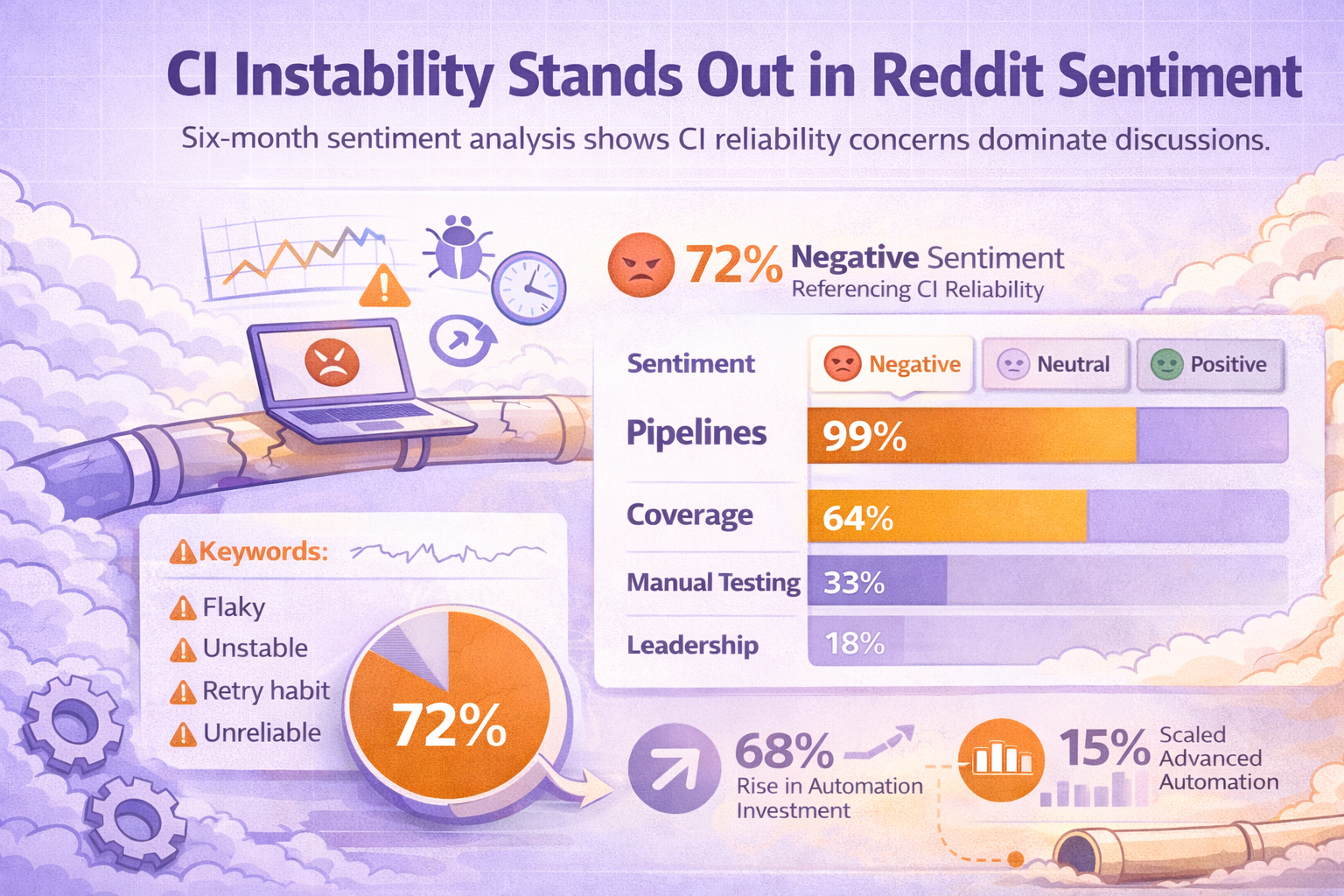
Industry reports from 2025–2026 tell a parallel story. The World Quality Report 2025–26 shows that 68% of organizations increased automation investment, yet only 15% have scaled advanced automation practices across the enterprise.
The gap between adoption and maturity aligns closely with Reddit sentiment. Investment is rising. Confidence is not rising at the same pace.
For CTOs, this is not just community mood. It is operational data. When teams do not trust the feedback loop, development slows and risk increases.
Coverage metrics are rising while confidence declines
Another strong pattern from the sentiment analysis was skepticism toward coverage metrics.
Using semantic analysis across coverage-related threads, we found:
- 64% negative sentiment when coverage targets were discussed
- 59% negative sentiment toward bug-count KPIs
- Only 21% positive sentiment in metric-related conversations
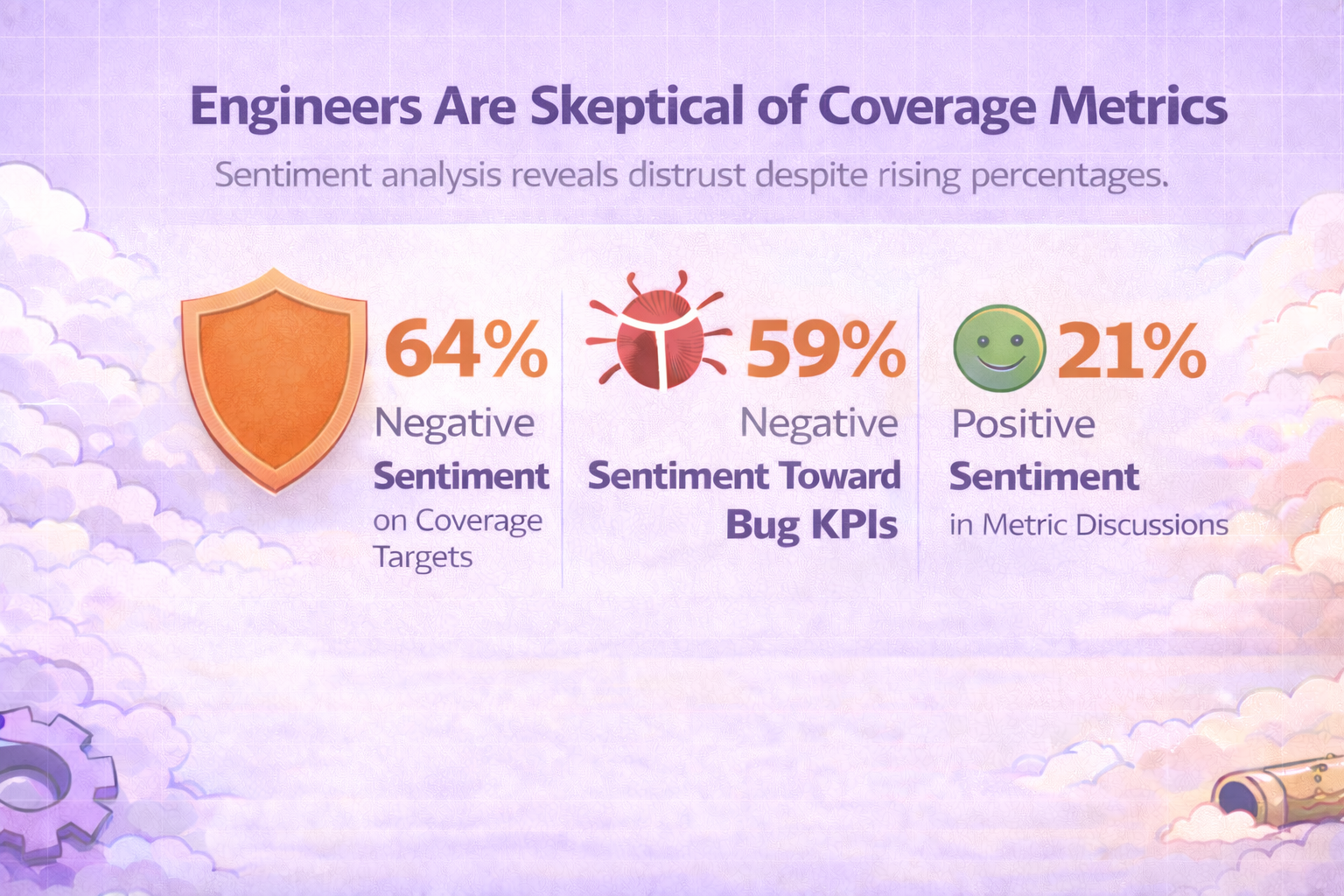
Engineers and testing professionals frequently expressed negative opinions about metrics that do not reflect real risk. Coverage percentages are increasing, but sentiment around their meaning is declining.
Now compare that to the 2026 State of Testing Report from PractiTest:
- 74% of teams track test coverage
- 68% track defect counts
- 65.6% of professionals express concern about the future of QA
Metrics are widely tracked. Confidence remains fragile.
This is where sentiment analysis becomes important. Survey responses often show what organizations measure. Reddit user feedback shows how practitioners feel about those measurements.
Manual testing maintains positive sentiment amid automation growth
One of the more interesting insights from the analysis is the relative positivity around manual testing.
Across manual testing discussions:
- 52% positive sentiment
- 33% neutral sentiment
- 15% negative sentiment
Comments frequently mention exploratory testing, usability validation, and edge-case discovery. The emotional tone is pragmatic rather than nostalgic.
External data supports this balance. The Stack Overflow Developer Survey shows that while 84% of developers use automated testing tools, 61% still perform manual testing in some form.
Automation adoption continues to grow. Manual testing continues to hold perceived value.
From a sentiment analysis perspective, this indicates that practitioners see manual testing as part of a stabilizing process. It compensates for automation weaknesses.
For CTOs, removing manual layers without stabilizing automated signals may increase internal resistance and reduce release confidence.
Leadership pressure amplifies negative sentiment
Threads that mentioned leadership expectations showed a noticeable spike in negative sentiment.
Approximately 58% of comments in these threads were classified as negative. Reddit users frequently referenced unrealistic automation volume targets or compressed delivery timelines.
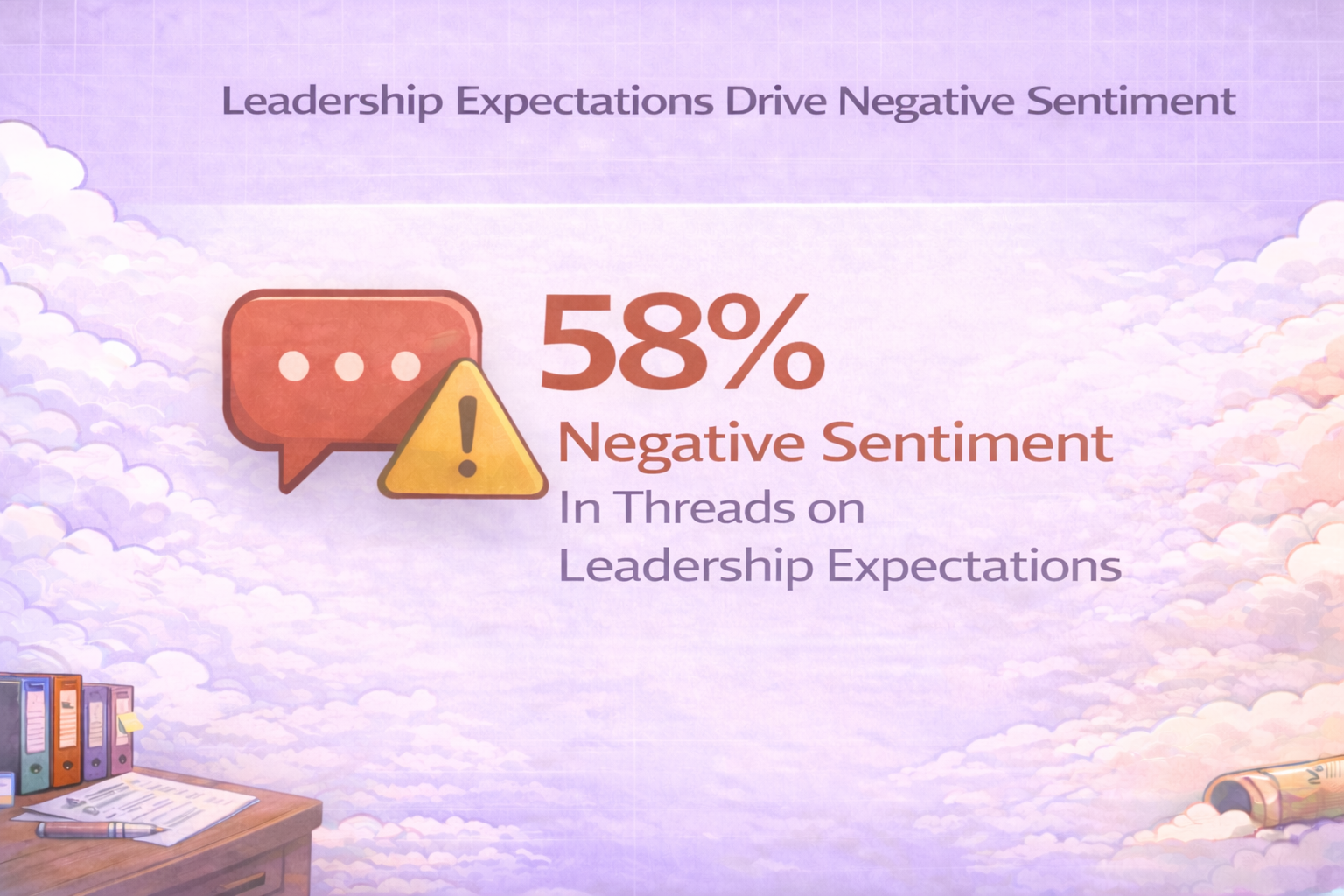
The language in these discussions often reflects tension between strategic goals and execution reality.
The World Quality Report 2025–26 notes that 56% of organizations struggle to balance speed and quality in DevOps environments.
The Reddit data mirrors that tension.
Automation quantity is often prioritized over signal accuracy. That imbalance increases negative sentiment and decreases perceived stability.
For CTOs, this indicates that governance of testing processes matters more than expanding tooling portfolios.
Career sentiment reflects broader structural uncertainty
Career-related threads showed 55% negative sentiment. Comments frequently referenced skill inflation, competition, and unclear role direction.
This aligns with broader workforce data from LinkedIn, which reports continued competition across technical hiring markets in 2025.
Career sentiment often functions as indirect user feedback about structural stability. When practitioners express uncertainty about role value, it frequently correlates with unclear quality ownership inside organizations.
For leadership, this affects retention, continuity, and long-term development stability.
The central insight from the analysis
Across automation, coverage metrics, manual testing, and leadership discussions, one pattern remains consistent.
Positive sentiment clusters around individual tools or small improvements. Negative sentiment clusters around signal reliability and process stability.
Industry reports show rising automation adoption, expanding machine learning experimentation, and broader artificial intelligence integration into workflows.
Reddit sentiment analysis shows declining confidence in test outputs.
That divergence is the key finding.
When practitioners consistently express negative sentiment about pipeline trust, it signals structural risk in the development process. And structural risk influences customer experience, brand reputation, and long-term business decisions.
The data does not suggest that testing is failing. It suggests that signal accuracy and trust need stronger focus than volume expansion.
What this means for CTOs in regulated industries
The sentiment analysis shows a consistent pattern: software testing professionals on Reddit are not primarily debating frameworks or tools. The strongest negative sentiment clusters around confidence in testing signals.
In regulated industries, that confidence gap carries measurable consequences.
Banking, fintech, and medtech operate under compliance scrutiny, audit requirements, and reputational sensitivity. In those environments, unstable test pipelines are not just inefficient. They increase business risk.
In banking, unstable signals translate into regulatory exposure
Consider a retail banking platform deploying updates to online payments, lending workflows, or identity verification systems.
When CI pipelines frequently fail for non-functional reasons, teams often introduce manual gates before release. That slows feature delivery and increases operational overhead.
More critically, inconsistent testing signals increase the likelihood of escaped defects in high-impact areas such as transaction authorization or account permissions.
In banking, production defects can trigger regulatory review, customer complaints, or financial penalties.
The World Quality Report 2025–26 highlights that financial services organizations report high pressure to balance release speed with compliance stability.
The negative sentiment expressed by software testing professionals on Reddit around flaky automation reflects friction inside these regulated environments. It signals strain in governance and validation processes.
For CTOs in banking, signal integrity affects audit readiness, change management control, and brand trust.
In fintech, velocity without reliability erodes user confidence
Fintech companies compete on rapid iteration. Payment integrations, API expansions, and real-time risk scoring models are deployed frequently.
However, the sentiment analysis shows strong negative feedback when automation volume increases without corresponding stability.
In fintech, that can appear as:
- Payment logic changes validated inconsistently
- Fraud detection updates insufficiently regression-tested
- Edge cases in cross-border transactions slipping through unstable pipelines
Customer trust in financial services is fragile. Minor defects in billing or transfers can generate immediate negative customer feedback across social media platforms and review sites.
Internal signal instability eventually manifests externally.
For CTOs, prioritizing reliable feedback loops directly influences customer experience and brand reputation.
In medtech, signal reliability intersects with safety and compliance
Medtech environments operate under even stricter regulatory frameworks.
Testing pipelines may validate:
- Diagnostic logic
- Clinical workflow software
- Medical device firmware updates
When software testing professionals express sustained negative sentiment about unreliable CI results, the implication in a medtech context is serious.
Inconsistent validation increases documentation overhead, slows certification processes, and raises compliance risk.
Regulatory audits require traceability and validation evidence. Flaky pipelines increase rework and reduce confidence in audit artifacts.
For CTOs in medtech, signal stability influences regulatory approval cycles, legal exposure, and patient safety outcomes.
The broader industry signal
Industry data from 2025–2026 shows rising automation investment and broader adoption of advanced tooling.
At the same time, sentiment analysis of discussions among software testing professionals on Reddit reveals concentrated negative feedback around reliability, process stability, and release confidence.
This divergence matters.
Automation expansion does not automatically increase trust. Tool adoption does not guarantee signal accuracy.
In regulated industries, declining confidence in testing signals affects:
- Audit outcomes
- Compliance assurance
- Release cadence
- Customer experience
- Brand reputation
Sentiment analysis is important because it surfaces structural friction early. It captures emotional tone across practitioners before issues appear in survey responses, customer feedback, or production incident reports.
When negative sentiment consistently clusters around signal reliability, leadership should interpret it as a governance warning.
Stabilizing pipelines, aligning metrics with real risk, and clarifying ownership of quality signals are strategic responsibilities.
In banking, fintech, and medtech, signal reliability is not a technical preference.
It is a business requirement.
Frequently asked questions
1. How can CTOs measure internal confidence in testing beyond traditional KPIs?
Most organizations track coverage, defect counts, and automation rate. Those metrics show activity, not confidence.
To measure confidence, leadership can introduce indicators such as:
- Flake rate per pipeline
- Retry frequency before successful builds
- Percentage of quarantined or disabled tests
- Time spent investigating non-product test failures
- Release rollback frequency
In addition, structured internal user feedback from software testing professionals can be collected quarterly and compared against operational data.
When operational metrics trend positive but internal sentiment trends negative, that gap becomes an early warning indicator.
Confidence is measurable. It just requires focusing on signal reliability rather than test volume.
2. How should organizations respond if internal sentiment mirrors the Reddit findings?
If internal sentiment shows similar patterns (frustration around unstable pipelines, skepticism about metrics, or pressure around automation volume) the response should focus on process stability.
Practical steps include:
- Stabilizing test environments before expanding test suites
- Investing in test data governance
- Reducing flaky test tolerance thresholds
- Aligning coverage metrics with escaped defect tracking
- Clarifying ownership of CI health
The goal is not to reduce automation. The goal is to improve signal accuracy.
In regulated industries such as banking or medtech, this also improves audit readiness and compliance documentation consistency.
3. Can sentiment analysis be applied inside an organization?
Yes, and it does not require complex infrastructure.
Internal sentiment analysis can be applied to:
- Retrospective notes
- Internal developer forums
- Slack discussions
- Post-release reviews
- Anonymous feedback forms
By classifying comments as positive, negative, or neutral and grouping them by theme, leadership can identify recurring friction points.
The purpose is not surveillance. It is structured listening.
When used responsibly, sentiment analysis becomes a governance tool. It helps leadership understand how the testing process is experienced on the ground, not just how it appears on dashboards.
Stop measuring activity. Start measuring risk.
Here’s the uncomfortable truth.
Most teams aren’t struggling because they lack automation. They’re struggling because they don’t fully trust what their automation tells them.
You can increase coverage. You can add more tests. You can invest in better tools. But if your pipeline is noisy, your metrics are detached from real business impact, and your critical flows aren’t clearly prioritized, you’re not reducing risk. You’re just creating the appearance of control.
Risk-based software testing is less about methodology and more about clarity.
- What can actually hurt the business?
- What would trigger regulatory scrutiny?
- What would damage customer trust?
Those areas deserve depth. Stability. Ownership. Strong signals. Everything else is secondary.
If you want to step back and assess your setup properly, use our risk-based software testing template. It’s designed to help you cut through coverage percentages and focus on what truly matters.


.png&w=3840&q=75)