.png&w=3840&q=75)
Looking for a new test automation platform? You're probably asking yourself one question:
"Will this actually make testing easier, or will it become another tool we spend more time maintaining than using?"
It's a fair concern. Many automation platforms look impressive during a demo, but day-to-day testing is very different. As applications evolve, interfaces change, releases become more frequent, and maintaining automated tests can quickly become the biggest challenge.
TestResults and Tricentis Tosca are both enterprise-grade test automation platforms, but they take different approaches to solving that challenge.
TestResults focuses on reducing maintenance and accelerating end-to-end business process testing through AI-assisted, model-based automation. It is designed for organisations that need to automate complex workflows across multiple applications while keeping maintenance effort low.
Tricentis Tosca is a mature enterprise automation platform built around model-based testing. It offers broad technology support and is widely adopted by large organisations, particularly those with dedicated automation teams and established testing processes.
Both tools support enterprise environments, but they differ significantly in implementation effort, usability, maintenance, and day-to-day experience.
This comparison looks beyond feature checklists and focuses on what matters most when selecting a test automation platform:
- test creation
- maintenance
- enterprise scalability
- integrations
- reporting
- licensing
- long-term cost of ownership
Whether you're modernising your QA strategy or replacing an existing automation framework, this guide will help you determine which platform is the better fit.
Not sure which platform fits your testing strategy?
Let's discuss your automation goals.
Quick overview: Which tool fits my needs?
| Use case | Best fit |
| Banking, insurance and regulated industries looking for low-maintenance end-to-end testing | TestResults |
| Organisations automating business processes across multiple systems | TestResults |
| Teams looking to expand automation beyond dedicated QA engineers | TestResults |
| Large enterprises with established Tosca expertise and existing model-based automation practices | Tricentis Tosca |
TestResults vs. Tricentis Tosca: key differences
🧪 Technical capabilities
| Feature | TestResults | Tricentis Tosca |
| Web Testing | ✅ Chrome, Firefox, Safari and Edge | ✅ Broad enterprise browser support |
| Mobile Testing | ✅ Android and iOS included with no separate mobile licensing | 🔶 Mobile testing supported through dedicated mobile capabilities and configuration |
| Desktop Testing | ✅ Full Windows desktop support, including legacy applications | ✅ Supports enterprise desktop technologies through technology-specific adapters |
| API Testing | ✅ Dedicated API testing that can run independently of the UI | ✅ API testing integrated into broader automation workflows |
| Parallel Execution | ✅ Built-in, highly scalable parallel execution | ✅ Parallel execution supported through distributed execution configuration |
| Deployment | ✅ Cloud-native, on-premises or hybrid | ✅ Cloud and on-premises deployment options |
| Enterprise Governance | ✅ Audit-ready reporting, revision history and visual evidence | ✅ Enterprise governance, audit trails and risk-based testing |
| Test Automation Approach | ✅ AI-assisted, model-based automation with natural language prompts | ✅ Model-based automation with drag-and-drop design |
| Cross-Application Testing | ✅ Designed for end-to-end business processes across web, desktop, mobile, email, PDFs and legacy systems | 🔶 Strong technology coverage, depending on supported technologies and adapters |
| Maintenance | ✅ Behaviour-based recognition reduces maintenance after UI changes | 🔶 Model updates remain part of long-term maintenance |
Web testing: TestResults vs. Tricentis Tosca
Both TestResults and Tosca support enterprise web application testing across modern browsers, making them suitable for large-scale digital applications.
The difference is less about browser coverage and more about maintenance. TestResults uses AI-assisted behavioural recognition that interacts with applications more like a human user. Small interface changes, such as moved buttons or updated layouts, typically require less maintenance, helping teams spend more time testing and less time fixing automation.
Tosca also provides robust web automation through its model-based architecture. For organisations with mature automation practices, this delivers excellent coverage, although maintaining application models remains part of the ongoing automation lifecycle.
Mobile testing: TestResults vs. Tricentis Tosca
Mobile testing is increasingly essential, especially for banks, insurers and enterprises delivering customer-facing applications.
TestResults includes Android and iOS automation as part of the platform, allowing teams to execute mobile tests on-premises or through mobile device farms without purchasing separate mobile functionality.
Tosca also supports mobile automation, but implementation typically involves additional configuration and technology components before teams can begin building mobile tests. Organisations already invested in the Tricentis ecosystem may not see this as a challenge, while teams looking for faster implementation may appreciate TestResults' simpler approach.
Desktop testing: TestResults vs. Tricentis Tosca
Many enterprise organisations continue to depend on Windows desktop applications, legacy software and core banking platforms that remain business critical.
TestResults supports Windows desktop automation out of the box, including older applications that frequently appear alongside modern web systems in end-to-end business processes. This allows teams to automate complete customer journeys without switching between multiple testing tools.
Tosca also provides strong desktop automation capabilities through technology-specific adapters. This works well for supported enterprise technologies, including SAP, although support depends on the technologies involved and the appropriate adapters being available. Organisations working with diverse legacy environments may therefore require additional planning during implementation.
API testing: TestResults vs. Tricentis Tosca
Both platforms provide enterprise-grade API testing.
TestResults offers dedicated API testing modules that can run independently of the user interface. This enables teams to validate backend services early, execute fast API regression suites and integrate API testing naturally into CI/CD pipelines.
Tosca also supports API automation as part of its model-based testing ecosystem. Organisations already managing end-to-end automation inside Tosca can include API validation within broader business workflows. The choice largely depends on whether teams prefer standalone API testing or a unified model-based automation approach.
Parallel execution: TestResults vs. Tricentis Tosca
Fast feedback is essential for modern release cycles.
TestResults includes highly scalable parallel execution out of the box, allowing teams to distribute test execution across multiple environments with minimal configuration.
Tosca also supports distributed and parallel execution, although enterprise teams generally spend more time configuring execution environments before achieving maximum scalability. Organisations with dedicated automation engineers may not consider this an issue, while lean QA teams often benefit from TestResults' faster setup.
Deployment: TestResults vs. Tricentis Tosca
Both platforms support cloud and on-premises deployments, giving enterprises flexibility when meeting internal security or compliance requirements.
TestResults was designed to support cloud-native deployments while also offering hybrid and fully on-premises installations for highly regulated industries such as banking and insurance.
Tosca provides similar deployment flexibility across enterprise environments. The primary difference lies less in deployment options themselves and more in implementation complexity and ongoing administration, where organisations looking for rapid adoption may find TestResults easier to roll out.
Enterprise governance: TestResults vs. Tricentis Tosca
Governance becomes increasingly important as automation scales.
TestResults provides revision-based reporting, complete execution evidence and visual proof of every test run. This makes collaboration between QA teams, developers, auditors and business stakeholders significantly easier, particularly in regulated industries where evidence is often just as important as the test result itself.
Tosca also offers comprehensive governance capabilities, including audit trails and risk-based testing. Enterprises with mature QA processes benefit from these features, although new users may find the overall platform more complex to navigate compared to TestResults' more visual reporting experience.
Test automation approach: TestResults vs. Tricentis Tosca
Both TestResults and Tosca use model-based automation.
The difference is how those models are created and maintained.
TestResults combines AI-assisted automation with model-based testing, allowing users to generate and maintain tests using natural language prompts while the platform builds the underlying automation model. This significantly lowers the barrier to entry for business users, manual testers and QA engineers alike.
Tosca follows a traditional model-based approach centred around reusable modules and drag-and-drop modelling. It remains one of the industry's most mature enterprise automation platforms, but organisations typically invest more time upfront designing and maintaining those models over the lifetime of the application.
🧑💻 User experience
| Feature | TestResults | Tricentis Tosca |
| Learning Curve | ✅ Most users can start creating automated tests within hours | 🔶 Model-based platform that benefits from structured onboarding |
| Test Creation | ✅ AI-assisted natural language generates the underlying automation model | ✅ Drag-and-drop model-based automation with reusable modules |
| Language Support (SUT) | ✅ Supports multilingual applications without maintaining separate test models | 🔶 Supports multilingual applications, though some model adjustments may be required |
| Reusability | ✅ Behavioural components and visual blocks simplify reuse across projects | ✅ Strong reusable module architecture |
| Automation Effort | ✅ Low effort thanks to AI-assisted modelling and behavioural recognition | 🔶 Higher initial effort due to model design and maintenance |
| Maintenance | ✅ Behaviour-based recognition reduces maintenance after UI changes | 🔶 Ongoing model maintenance remains part of the automation lifecycle |
| Team Onboarding | ✅ Fast onboarding with dedicated implementation guidance | 🔶 Better suited to organisations with established automation practices |
| Dashboard | ✅ Visual dashboards with execution evidence and complete test history | ✅ Enterprise dashboards and execution analytics |
| Reporting | ✅ Evidence-based reporting designed for developers, QA and auditors | ✅ Comprehensive enterprise reporting |
Learning curve: TestResults vs. Tricentis Tosca
Both TestResults and Tosca are designed for enterprise automation, but they differ in how quickly teams become productive.
TestResults allows users to describe tests using natural language while automatically generating the underlying automation model. Business analysts, manual testers and QA engineers can therefore contribute to automation without spending weeks learning a specialised framework.
This broader accessibility is particularly valuable in banking and enterprise environments, where business experts often understand critical customer journeys better than developers.
Tosca also removes the need for traditional scripting through model-based automation. However, users generally spend more time learning how application models, reusable modules and execution structures work before they can build larger automation suites efficiently. Organisations with dedicated automation teams typically benefit the most from this approach.
Test creation: TestResults vs. Tricentis Tosca
Both platforms simplify test automation compared to traditional coded frameworks.
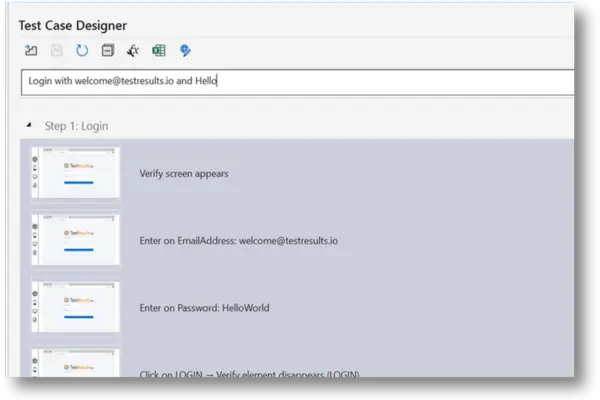
With TestResults, users describe business processes in natural language and the platform generates the corresponding automation model. Because AI assists throughout test creation, new automation can often be produced significantly faster while remaining understandable to both technical and non-technical stakeholders.
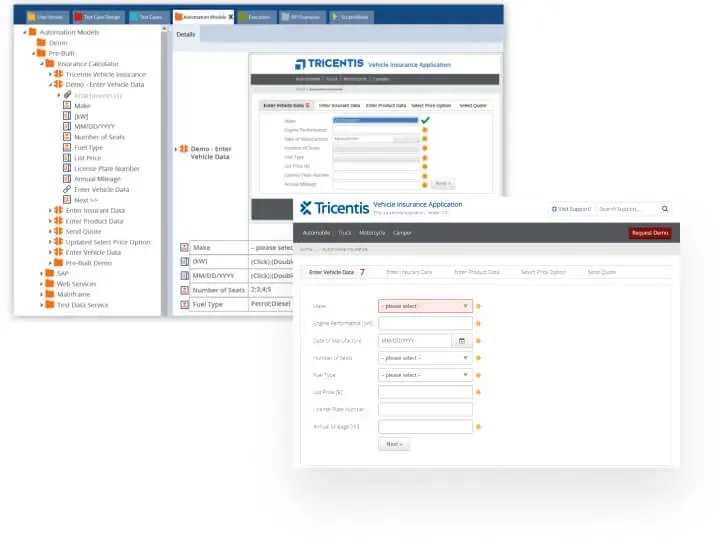
Tosca also follows a model-based approach, using drag-and-drop modules and reusable components instead of code. This provides excellent consistency across large automation projects but generally involves more manual modelling before tests are ready to execute.
Language support (SUT): TestResults vs. Tricentis Tosca
International organisations frequently test the same application across multiple languages.
TestResults can automate multilingual interfaces without maintaining separate automation suites for each language. Because the platform focuses on application behaviour rather than static interface elements, teams can reuse the same tests across different language versions more easily.
Tosca also supports multilingual applications through its model-based architecture. Depending on how applications are designed, teams may need to maintain language-specific adjustments within their models, increasing long-term maintenance for globally deployed applications.
Reusability: TestResults vs. Tricentis Tosca
Reusability is essential for keeping enterprise automation scalable.
TestResults enables teams to reuse behavioural components and visual building blocks across multiple business processes. Because these components focus on user behaviour rather than specific UI elements, the same automation can often be applied across different applications with minimal modification.
Tosca has long been recognised for its reusable module architecture. Well-designed models allow enterprise teams to build highly structured automation libraries, although maintaining those libraries typically requires stronger governance as projects grow.
Automation effort: TestResults vs. Tricentis Tosca
Automation success depends on more than creating tests—it depends on how much effort is required to maintain them over time.
TestResults reduces automation effort by combining AI-assisted modelling with behavioural recognition. Teams spend less time configuring automation and less time updating tests after interface changes, making it easier to expand automation coverage across complex business processes.
Tosca's model-based approach also reduces coding effort compared to traditional automation frameworks. However, designing, maintaining and governing application models generally requires greater upfront investment, particularly for organisations with rapidly changing applications.
Test maintenance: TestResults vs. Tricentis Tosca
Maintenance is often the biggest hidden cost of enterprise automation.
TestResults interacts with applications based on user behaviour rather than relying solely on technical object recognition. Small interface updates—such as moving buttons, changing layouts or updating colours—typically do not require immediate test rewrites. Instead, teams decide whether a detected change represents an actual functional issue.
For organisations releasing software every few weeks, this significantly reduces maintenance overhead while improving long-term automation stability.
Tosca also aims to minimise maintenance through reusable models. Nevertheless, application models remain central to the platform, meaning UI and application changes still require ongoing updates as systems evolve.
Team onboarding: TestResults vs. Tricentis Tosca
Rolling out enterprise automation successfully depends on how quickly teams can adopt the platform.
TestResults combines guided implementation with a user experience designed for both technical and business users. Many organisations begin creating production-ready automated tests within days rather than weeks.
Tosca provides extensive enterprise training resources and certification programmes that support long-term adoption. While this creates a structured learning path, organisations should generally expect a longer onboarding period before teams become fully productive.
Dashboard: TestResults vs. Tricentis Tosca
Both platforms provide enterprise reporting dashboards.
TestResults presents execution history, screenshots, evidence and revision history through a highly visual interface. This allows QA engineers, developers, business stakeholders and auditors to review failures using the same information, reducing communication overhead during releases.
Tosca also provides enterprise dashboards with execution tracking and analytics. These dashboards expose significant operational detail and work particularly well for mature QA organisations already familiar with the Tosca ecosystem.
Reporting: TestResults vs. Tricentis Tosca
Reporting should help teams make release decisions—not simply display execution statistics.
TestResults generates evidence-based reports that clearly document every automated step, making it easier to investigate failures and demonstrate compliance during audits. This is particularly valuable in banking, insurance and other highly regulated industries.
Tosca offers comprehensive enterprise reporting and traceability as well. Organisations with mature governance processes benefit from these capabilities, although many teams may prefer the simpler, more visual reporting style provided by TestResults for day-to-day collaboration.
🔌 Integration & ecosystem
| Feature | TestResults | Tricentis Tosca |
| CI/CD Integration | ✅ Native integrations with Jenkins, GitLab, Azure DevOps, Jira, Xray and more | ✅ Enterprise CI/CD integrations |
| ALM & Test Management | ✅ Jira/Xray, REST API and integrations with 3,000+ applications via Zapier | ✅ Enterprise ALM ecosystem and Tricentis products |
| Third-Party APIs | ✅ Open REST API for custom integrations | ✅ REST APIs and enterprise integrations |
| End-to-End Process Automation | ✅ Automates complete business processes across web, desktop, mobile, email, PDFs and legacy systems | 🔶 Strong technology support across supported applications |
CI/CD integration: TestResults vs. Tricentis Tosca
Modern software teams expect automated testing to fit naturally into their delivery pipeline.
TestResults integrates with popular DevOps and CI/CD platforms including Jenkins, GitLab, Azure DevOps, Jira and Xray. Automated tests can be triggered directly from deployment pipelines, helping teams receive fast feedback before software reaches production.
Tosca also integrates with leading CI/CD platforms and enterprise DevOps environments. Organisations already invested in the Tricentis ecosystem benefit from a mature integration landscape. The main difference is not whether integrations exist, but how quickly teams can begin using them with minimal configuration.
ALM tools: TestResults vs. Tricentis Tosca
Automation rarely exists in isolation.
TestResults connects with Jira, Xray, REST APIs and thousands of additional applications through Zapier. This allows QA teams to integrate testing into existing development workflows without introducing additional complexity.
Tosca provides strong integrations with enterprise ALM solutions and works particularly well within organisations already standardising on the broader Tricentis platform. Teams evaluating new automation solutions should consider how each platform fits their existing technology landscape rather than simply comparing the number of integrations available.
Third-party APIs: TestResults vs. Tricentis Tosca
Enterprise organisations often need automation platforms to integrate with internal dashboards, reporting systems and proprietary applications.
TestResults exposes an open REST API, allowing organisations to build custom integrations while maintaining flexibility as their tooling evolves.
Tosca also provides API-based integration capabilities for enterprise environments. The decision typically comes down to whether teams prioritise flexibility and lightweight integration or deeper integration within an established enterprise automation ecosystem.
End-to-end business process automation: TestResults vs. Tricentis Tosca
One of the biggest differences between the two platforms is how they approach business process testing.
TestResults was built around complete user journeys rather than individual applications. A single automated test can move seamlessly between desktop applications, browser-based systems, mobile devices, emails, PDFs, terminal applications and legacy platforms without switching tools.
This makes TestResults particularly well suited for banking, insurance and other enterprise environments where a single customer transaction often spans numerous independent systems.
Tosca also supports broad enterprise technology coverage through its model-based architecture and technology adapters. However, organisations automating highly heterogeneous environments may find TestResults' unified approach to cross-application testing easier to implement and maintain over time.
💰 Licensing
| Feature | TestResults | Tricentis Tosca |
| License Model | ✅ Transparent user-based licensing | 🔶 Enterprise licensing tailored to organisation size and usage |
| Implementation & Support | ✅ Onboarding, implementation guidance and support included | 🔶 Enterprise implementation and additional services depending on deployment |
License model: TestResults vs. Tricentis Tosca
Licensing plays an important role in the total cost of ownership of any automation platform.
TestResults keeps licensing straightforward with a transparent user-based model. Organisations can estimate costs more easily while benefiting from onboarding and implementation guidance as part of the customer journey.
Tosca uses enterprise licensing that can be tailored to an organisation's requirements, technology landscape and deployment model. While this provides flexibility for large enterprises, understanding the overall investment often requires a more detailed licensing discussion.
Implementation and support: TestResults vs. Tricentis Tosca
The cost of a test automation platform extends beyond software licenses.
TestResults includes onboarding, implementation guidance and customer support to help teams become productive quickly. This reduces time to value and lowers the effort required to introduce automation across development teams.
Tosca implementations are typically planned as larger enterprise projects and may involve additional professional services depending on organisational requirements, existing infrastructure and deployment scope. For organisations looking to implement automation rapidly with smaller teams, TestResults often provides a faster path from evaluation to production.
💬 Support & community
| Feature | TestResults | Tricentis Tosca |
| Official Support | ✅ Personal onboarding, responsive support and direct access to experts | ✅ Enterprise-grade global support |
| Community | 🔶 Growing knowledge base and customer community | ✅ Large global enterprise community |
| Documentation | ✅ Modern, task-oriented documentation | ✅ Extensive enterprise documentation |
| Training | ✅ Guided onboarding and self-service learning | ✅ Extensive training and certification programmes |
Official support: TestResults vs. Tricentis Tosca
The quality of support can significantly influence how quickly organisations realise value from a new automation platform.
TestResults provides direct onboarding, implementation guidance and responsive technical support. Customers work closely with product specialists throughout implementation, making it easier to overcome technical challenges and expand automation across teams.
Tosca offers enterprise-grade global support backed by one of the largest testing vendors in the market. Organisations with large international deployments benefit from its mature support organisation, although customers often work through more structured enterprise support processes.
Community: TestResults vs. Tricentis Tosca
Tosca has one of the largest user communities in enterprise test automation, supported by years of adoption across global organisations.
TestResults has a smaller but rapidly growing community supported by close collaboration between customers and product specialists. Organisations looking for direct interaction with the development team often appreciate this more personal approach.
Documentation: TestResults vs. Tricentis Tosca
TestResults focuses on practical documentation designed to help teams become productive quickly. Guides are written around real automation scenarios, making them accessible for both technical and business users.
Tosca provides extensive enterprise documentation covering its large feature set and technology ecosystem. While comprehensive, the breadth of available documentation can be more challenging for new users navigating the platform for the first time.
Training: TestResults vs. Tricentis Tosca
TestResults combines guided onboarding with self-service learning resources, allowing organisations to adopt automation at their own pace.
Tosca provides a mature training ecosystem including formal learning paths and certifications that support enterprise-scale automation programmes. This structured approach is valuable for organisations building dedicated automation centres of excellence, although it generally represents a larger initial investment in training.
📈 Roadmap & future-proofing
| Feature | TestResults | Tricentis Tosca |
| AI-Assisted Automation | ✅ AI is integrated directly into test creation and maintenance workflows | ✅ AI capabilities continue to expand across the Tricentis platform |
| Adapting to Change | ✅ Behaviour-based recognition reduces maintenance after UI changes | 🔶 Model updates remain an important part of long-term automation |
AI-assisted automation: TestResults vs. Tricentis Tosca
Artificial intelligence is rapidly changing how organisations build and maintain automated tests.
TestResults places AI at the centre of the automation experience. Users can describe business processes in natural language while the platform generates and maintains the underlying automation model. This helps teams automate faster while reducing long-term maintenance effort.
Tosca has also introduced AI-assisted capabilities that simplify test creation and improve productivity. Rather than replacing its model-based architecture, AI complements the existing workflow by helping users generate and enhance automation assets. Organisations already invested in Tosca benefit from these additions, while teams prioritising AI-first workflows may prefer TestResults' more integrated experience.
Adapting to changing applications: TestResults vs. Tricentis Tosca
Enterprise software changes constantly.
New releases, redesigned interfaces and evolving business processes all place pressure on automated tests.
TestResults uses behavioural recognition to reduce the impact of many interface changes. Because automation follows how users interact with applications rather than depending solely on technical objects, teams spend less time repairing automation after routine UI updates.
Tosca's model-based architecture also improves maintainability compared to traditional scripted automation. However, maintaining application models remains an ongoing activity as enterprise systems evolve, particularly across large automation portfolios.
Which test automation platform should you choose?
Both TestResults and Tricentis Tosca are capable enterprise automation platforms that support modern quality assurance teams.
The better choice depends on your organisation's priorities.
Choose TestResults if you want to:
- automate complete business processes across multiple applications
- reduce long-term maintenance
- involve business users alongside QA engineers
- accelerate implementation and time-to-value
- improve collaboration between QA, development and business teams
- support complex enterprise and banking environments with lower operational overhead
Choose Tricentis Tosca if your organisation:
- already has significant Tosca expertise
- has established model-based automation practices
- wants to standardise on the wider Tricentis ecosystem
- has dedicated automation engineers managing enterprise-scale test portfolios
For many organisations (particularly banks, insurers and other regulated enterprises--). the biggest challenge is no longer creating automated tests. It's maintaining them efficiently while keeping pace with increasingly frequent software releases.
That's where TestResults stands out.
By combining AI-assisted model-based automation with behaviour-based recognition, TestResults enables organisations to automate complex end-to-end business processes while significantly reducing maintenance effort and accelerating delivery.
👉 Already using another automation platform, including Tosca?
You don't have to start over.
TestResults helps organisations migrate existing automation assets and modernise their testing strategy without rebuilding everything from scratch.
If you're ready to reduce maintenance, increase automation coverage and accelerate enterprise testing, we'd love to show you how.
See how TestResults simplifies enterprise test automation
Book a personalised demo with one of our automation specialists.