

The World Quality Report 2025 - 2026, published by Capgemini and Sogeti in collaboration with OpenText, is the only global report fully focused on quality engineering and testing. Each annual edition brings together insights from many organizations, supported by interviews with senior executives across industries.
At TestResults, we want this information to be accessible to more people working in quality engineering, testing, and delivery. The full quality report 2025 - 2026 is extensive and detailed, which makes it valuable but also time-consuming to digest. That is why we synthesized the most important trends, key takeaways, and expert findings from the world quality report, focusing on what matters in day-to-day work.
The year’s theme, adapting to emerging worlds, reflects the reality many teams face. Software environments are more complex, expectations are higher, and quality engineering practices increasingly determine how organizations deliver, scale, and stay reliable.
Who the World Quality Report 2025 - 2026 is relevant for
The edition of the world quality report speaks to a broad audience, but its relevance is especially strong for people directly responsible for delivery quality.
This includes quality professionals, QE experts, engineering managers, and leaders overseeing enterprise functions that depend on stable software. It also matters for teams scaling agile methodologies, coordinating agile teams, or navigating complex delivery environments where testing, automation, and data quality intersect.
Across organizations, the report shows that challenges in quality engineering and testing are strikingly consistent. Differences in outcomes are rarely driven by tooling alone. They are shaped by organizational structure, skills, and how responsibility for quality is distributed.
Why quality engineering and software testing now shape leadership decisions
One of the clearest messages in the World Quality Report 2025 - 2026 is that quality engineering testing has moved into the leadership conversation.
According to the report:
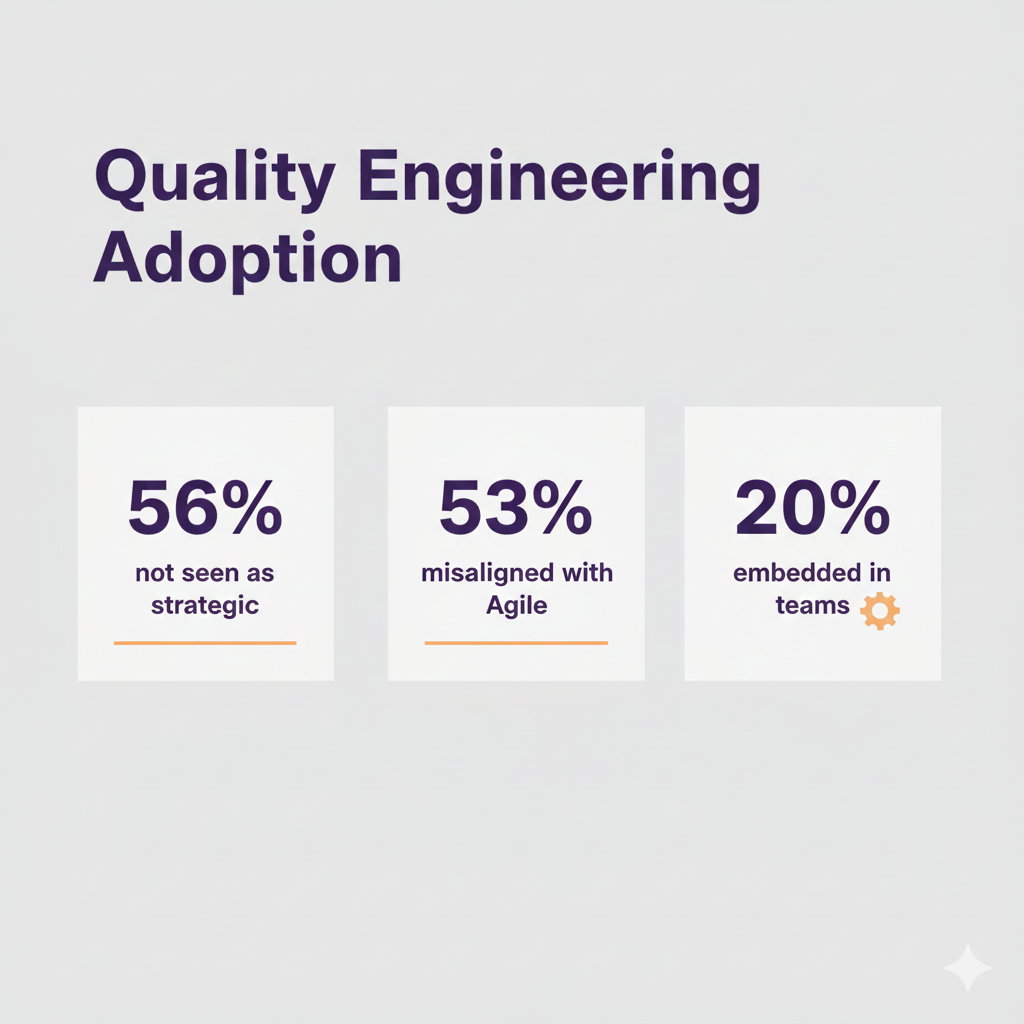
- 56% of organizations do not yet view QE as a strategic function
- 53% report misalignment between QE processes and agile methodologies
- Only 20% have quality engineering fully embedded in agile teams
At the same time, delivery expectations continue to rise. Teams are expected to deliver faster, reduce risk, and maintain reliable engineering across growing system complexity.
This combination explains why quality engineering increasingly influences planning, architecture, and release decisions across enterprise functions. In many environments, QE now defines whether teams can move quickly without sacrificing trust.
Gen AI in quality engineering: present, but unevenly applied
The World Quality Report 2025 - 2026 confirms that gen AI and agentic technologies are no longer distant concepts. They have already penetrated QE, influencing how teams approach testing trends, data generation, and analysis.
The data shows:
- 15% of organizations have scaled Gen AI across quality engineering
- 30% use it in operational testing workflows
- 43% remain in experimentation
- 11% report no Gen AI adoption
Among adopters, the average productivity improvement is 19%, but 33% report very limited gains. The report links this gap to missing gen AI skills, unclear ownership, and lack of structure rather than technology limits.
The transformative potential of AI is acknowledged, but the report stresses the need to scale responsibly. Without the right skills, governance, and accountability, AI-supported testing struggles to deliver consistent value.
Test automation and automation coverage show where maturity really sits
Test automation remains a central theme in the quality report, and the numbers reveal a persistent gap between intent and execution.
Average automation coverage sits at 33%, nearly 50% of organizations remain in the planning stage, and only 8% report a fully established automation strategy.
The report makes clear that teams able to accelerate test automation treat it as part of test design rather than a follow-up task. These teams apply shift left principles, integrate automation early, and align testing with delivery models. Others continue to struggle with fragmented tools and unclear ownership.
In practice, automation reflects discipline more than ambition.
Data quality and synthetic data as gating factors
As AI-driven transformation progresses, data quality has become one of the strongest constraints in software testing and quality engineering practices.
The World Quality Report 2025 - **2026 **shows:
- 95% of organizations use AI for test data generation
- Only 10% have fully integrated AI-driven test data management
- 35% rely on synthetic data for more than a quarter of their test data
Despite this reliance, nearly 50% of organizations lack centralized ownership for test data. This fragmentation directly affects confidence, compliance, and long-term reliability, particularly in regulated industries.
Skills, structure, and rethinking roles
Another recurring insight across the world quality report is the importance of people and structure.
Only 53% of testers have received AI or machine learning training. 46% of organizations have introduced AI-focused roles, and 37% report strong cross-functional collaboration.
The year’s edition emphasizes rethinking roles and investing in new skills. Progress depends less on technology choices and more on how organizations assign ownership, support learning, and integrate QE into delivery models.
As Mark Buenen, global leader for Quality Engineering & Testing at Capgemini, highlights in the year’s report, quality now sits at the center of how teams adapt fastest in uncertain environments, turning ambiguity into direction.
What to keep in mind from the World Quality Report 2025 - 2026
The key recommendations and key takeaways from the annual edition are consistent across sections:
Quality engineering stands as a strategic discipline. Software testing, automation, and data quality require clear ownership. Gen AI adoption depends on skills and governance. Quality engineering and testing shape how teams stay agile and build competitive advantage.
Compared to the World Quality Report 2024, this year’s report shows more acknowledgment of responsibility placed on QE teams and a stronger focus on execution over experimentation.
Closing perspective
The World Quality Report 2025 - 2026 offers grounded insights into the most important trends shaping the next generation of quality engineering and software testing. In new futures defined by speed, complexity, and constant change, quality provides the structure that supports confidence and control.
For teams looking to apply these insights in everyday work, TestResults’ software testing cheatsheet offers a practical reference. It helps connect testing, automation, and quality decisions to the realities highlighted throughout the world quality report, supporting teams as they focus on what matters most.



.png&w=3840&q=75)