Most teams don’t struggle with how to test. They struggle with what to test.
If your test reports are green but production issues keep slipping through, the problem is rarely a lack of testing. More often, it’s a lack of risk-based testing.
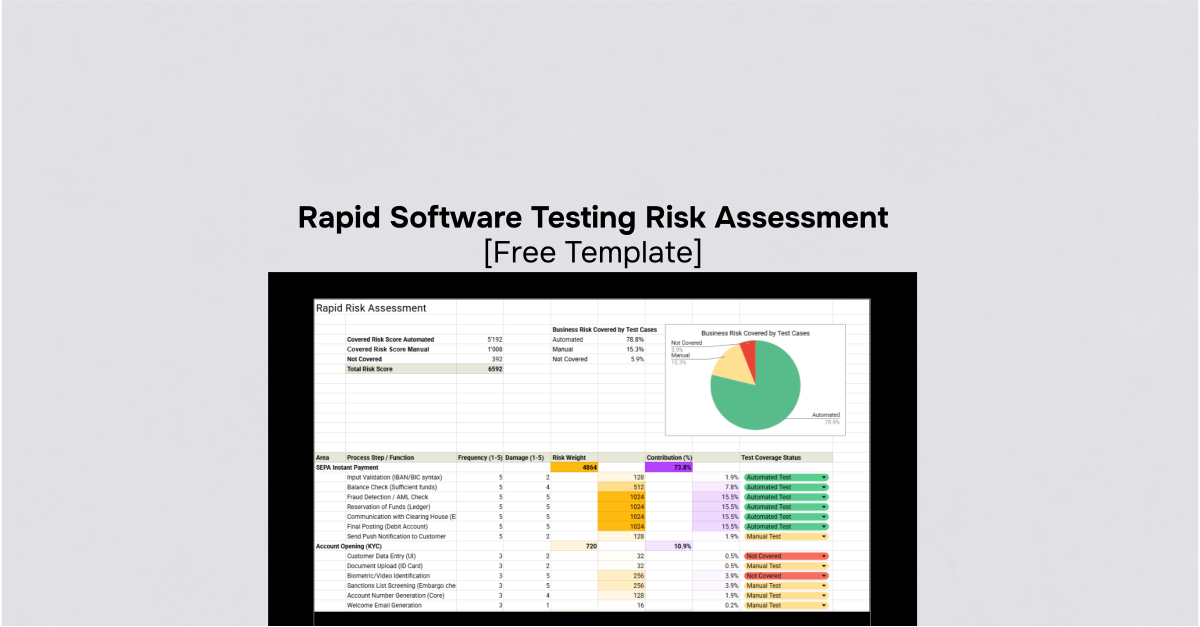
This article explains how risk-based testing works in practice, why traditional testing metrics fail, and how you can drastically reduce test volume while increasing confidence using a simple Rapid Risk Assessment template.
Your 20-Second TL;DR
- The problem: Most teams have high test coverage but low risk coverage. This leads to bloated test suites, slow pipelines, and production bugs that should never have slipped through.
- The cost: Green dashboards that create false confidence, recurring production incidents, and excessive time spent maintaining and automating unnecessary test cases.
- The fix: Shift your focus from test or code coverage to business risk coverage. Audit your test suite using a Rapid Risk Assessment (RRA) to identify what actually matters.
- The result: Cut up to 80% of your test cases while increasing your safety net.
- The tool: Get the free Rapid Risk Assessment Template and step-by-step guidance to cut the fluff and move to risk-based testing.
High Test Coverage, Low Quality: The Hidden Cost of Green Reports
Your dashboard is all green.
100% of your test execution passed.
You deploy.
Two hours later, a major customer calls because they can’t complete a transaction.
This is the reality behind many “successful” releases.
According to the 2025 Quality Transformation Report, 40% of organizations estimate losses of over $1 million per year due to poor software quality. In financial services, 50% of companies report losses exceeding $5 million annually.
These numbers matter because most of these organizations are not under-testing.
They are over-testing the wrong things.
Teams invest heavily in comprehensive test coverage, automate aggressively, and still ship defects in critical functionalities. The issue is not the lack of test cases. It is the absence of a risk-based testing process.
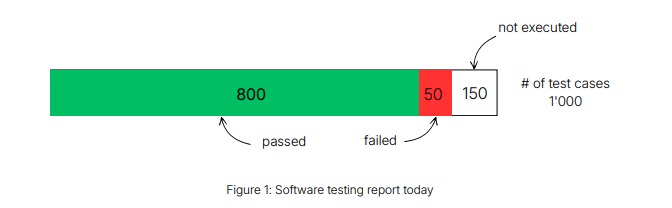
A green report only tells you that scripts passed. It tells you nothing about:
- Critical risks
- High risk areas
- Potential failures
- Real risk exposure
Relying on pass rates alone is like flying a plane while staring at the passenger count instead of the altimeter. You feel safe until impact.
Why Traditional Testing Metrics Fail at Scale
Metrics like test coverage, pass rate, and even code coverage are popular for one simple reason: they are easy to measure. Dashboards fill up automatically, numbers go up, and progress appears visible.
The problem is that these metrics are proxies, not outcomes.
They tell you how much testing activity happened, not whether that activity reduced risk or improved software quality.
A test passing only confirms that a predefined script behaved as expected in a controlled scenario. It does not tell you:
- Whether a critical business flow is protected
- Whether a failure would block revenue or users
- Whether the most significant risks were even tested
As test suites scale, this gap becomes more pronounced.
As more test cases are added:
- Testing resources are spread thinner, because execution time, maintenance effort, and review capacity all increase
- Low risk test cases dominate test execution, simply because they are easier to automate and already exist
- High risk tests remain shallow or incomplete, often limited to happy paths with little coverage of failure modes, edge cases, or real-world data behavior
In other words, scale amplifies the wrong things.
The result is predictable and visible across many organizations:
- Bloated test suites that are expensive to maintain
- Slower pipelines that delay feedback and releases
- Declining testing effectiveness, even though coverage numbers continue to rise
Teams end up running more tests than ever, while trusting their results less.
This is where risk-based testing fundamentally changes the equation.
Instead of optimizing for volume, it optimizes for intent.
Instead of asking “How many tests did we run?”, it asks “Which risks did we reduce?”
That shift is what allows testing to scale without collapsing under its own weight.
What Risk-Based Testing Really Means
Risk-based testing (RBT) is a software testing technique that prioritizes testing activities based on risk levels, rather than treating all functionality as equally important.
Traditional testing approaches often aim for broad or comprehensive test coverage. Risk-based testing deliberately does the opposite. It accepts that time, tooling, and testing resources are limited, and that not all defects have the same impact.
At its core, risk-based testing focuses on four tightly connected activities:
- Risk identification – understanding what could go wrong in the system, from functional failures to data issues, performance problems, or security gaps
- Risk analysis – assessing the likelihood and impact of those potential failures
- Risk evaluation – comparing risks against each other to determine which ones matter most
- Risk mitigation through targeted testing – designing and executing tests specifically to reduce the highest risks
This moves testing from a mechanical activity into a decision-making discipline.
Instead of aiming for comprehensive test coverage everywhere, risk-based testing deliberately focuses testing efforts on:
- Critical areas of the application that support core business workflows
- High risk areas where failures are likely or historically frequent
- Significant risks tied to revenue, compliance, security, or customer trust
- Identified risks with the highest business impact, not just the highest technical complexity
This is what makes risk-based testing both a testing strategy and a risk management discipline. It connects test planning and execution directly to business outcomes, not just technical completeness.
The Financial Cost of Ignoring Risk
When teams do not perform risk-based testing, testing effort is almost always misallocated.
A consistent pattern appears across organizations and industries:
- Roughly 10% of test cases cover around 50% of business risk
- The remaining 90% of test cases consume the majority of execution time, maintenance effort, and automation cost, while adding only marginal protection
Despite this imbalance, most teams continue to maintain and execute all tests equally. Over time, this creates a false sense of safety and a growing operational burden.
The cost is not only financial.
It is also organizational:
- Developers stop trusting test results, because failures are noisy and often irrelevant
- Releases are delayed, not because critical issues are found, but because teams are sorting through low-value failures
- Critical defects escape to production, because the areas that truly matter were never tested deeply enough
In extreme cases, teams spend more time maintaining tests than learning from them.
Risk-based testing addresses this imbalance directly. By aligning testing effort with real risk, teams reduce waste, restore trust in test results, and focus their energy where failures would actually hurt.
The Risk-Based Testing Approach That Actually Works
You do not need a six-month transformation project to implement risk-based testing. What you need is a clear, structured way to assess risks and translate those insights into practical testing decisions.
Many teams struggle with risk based testing (RBT) because it stays abstract. Risks are discussed, but testing efforts grow organically, test cases accumulate, and priorities remain unclear. As a result, teams invest in comprehensive test coverage without understanding which business risks are actually protected.
This is where the Rapid Risk Assessment (RRA) becomes effective.
Turning Risk Into Actionable Testing Decisions
The RRA provides a practical way to perform risk based testing without disrupting the development lifecycle. It connects risk identification and risk analysis directly to your testing strategy and test execution.
Instead of treating all functionality equally, the risk based testing approach helps teams:
- Prioritize testing efforts based on risk
- Focus on critical functionalities and high risk areas
- Align testing efforts with real risk levels and impact
A Scalable Approach for Agile Teams
Risk-based testing works especially well in agile environments, where change is constant and risk levels shift frequently. By regularly reassessing risks, teams can adjust their testing process without rebuilding the entire test suite.
Over time, this leads to optimized test coverage. Not broader coverage, but coverage that actually protects the areas where failure would hurt most.
The Playbook: Rapid Risk Assessment
The Rapid Risk Assessment (RRA) provides a structured way to apply risk-based testing in real software testing environments. It translates abstract risk discussions into concrete inputs for the testing strategy, test planning, and test execution.
Instead of relying on broad or comprehensive test coverage, the RRA supports a risk-based testing approach that aligns testing efforts with actual business risks. It gives the software testing team a shared framework for risk identification, risk analysis, and prioritizing testing across the development lifecycle.
Step 1: List All Business-Relevant Functions
Start by listing all core application functions from a business perspective. These functions represent the behaviors and workflows that users, customers, and internal teams depend on.
Typical examples include:
- User login and authentication
- Payment processing and transaction handling
- Database updates and data persistence
- Reporting, exports, and integrations
- Security-sensitive actions and access control
This step supports early risk identification and often exposes misalignment between existing test cases and actual critical areas. Many teams discover that a large portion of their testing efforts target low risk functionality, while high risk areas receive limited attention.
Step 2: Perform Risk Assessment Using Two Factors
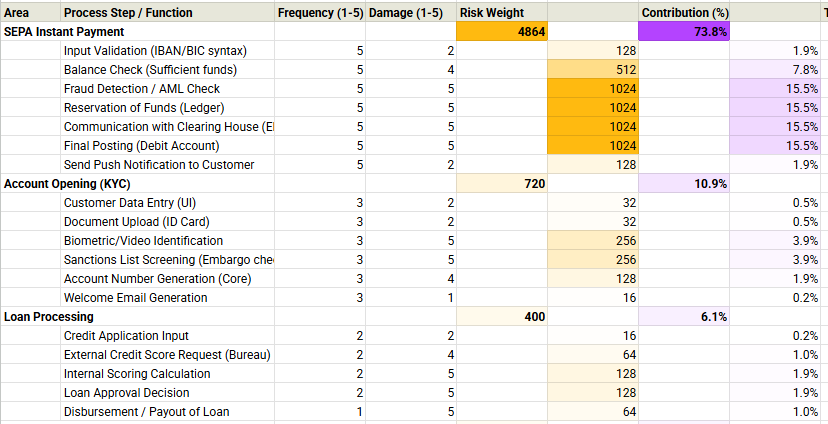
Each function is assessed using two clearly defined risk factors, scored on a scale from 1 to 5. This creates a consistent input for risk analysis across the entire testing process.
Frequency (likelihood of use):
- 1 = Almost never used
- 5 = Used in every transaction or continuously
Damage (impact of failure):
- 1 = Minor inconvenience
- 5 = Financial loss, legal exposure, security incidents, or severe customer impact
This step helps identify potential risks that often remain implicit. By scoring frequency and damage separately, teams surface associated risks tied to usage patterns, failure modes, and business impact.
Step 3: Analyze Risk Using a Simple Formula
Risk is calculated by multiplying Frequency × Damage, producing a clear risk rating for each function.
- Higher scores indicate critical risks and high-risk areas that require deeper testing and more reliable test automation
- Lower scores indicate low-risk functionality that may only require minimal coverage
The Rapid Risk Assessment Template calculates these risk levels automatically and visualizes overall risk exposure. This allows teams to prioritize testing efforts based on objective criteria rather than assumptions or historical habits.
👉 Download the free Rapid Risk Assessment Template to perform this analysis quickly and consistently across projects.
Pro Tip: The Silent Approval Rule
Risk ranking sessions often slow down due to extended discussion. The RRA avoids this by applying a simple rule.
Present the risk assessment matrix and resulting rankings.
If no objections are raised, the ranking is accepted.
This approach keeps risk evaluation efficient, reduces meeting overhead, and maintains focus on outcomes rather than debate. It also helps align business analysts, the development team, and the software testing team around a shared understanding of highest risk areas.
Step 4: Prioritize Your Testing Using the Three Risk Dimensions
Once function risks are weighted, the next step is translating that insight into concrete test cases. Most teams already have an intuitive sense of this. Roughly 10% of test cases usually cover about 50% of business risk. These are typically happy paths or basic smoke tests.
This is also where many teams stop.
Happy path testing confirms that a feature works under ideal conditions. That level of coverage accounts for roughly half of the total business risk. The remaining risk sits outside perfect user behavior and clean data.
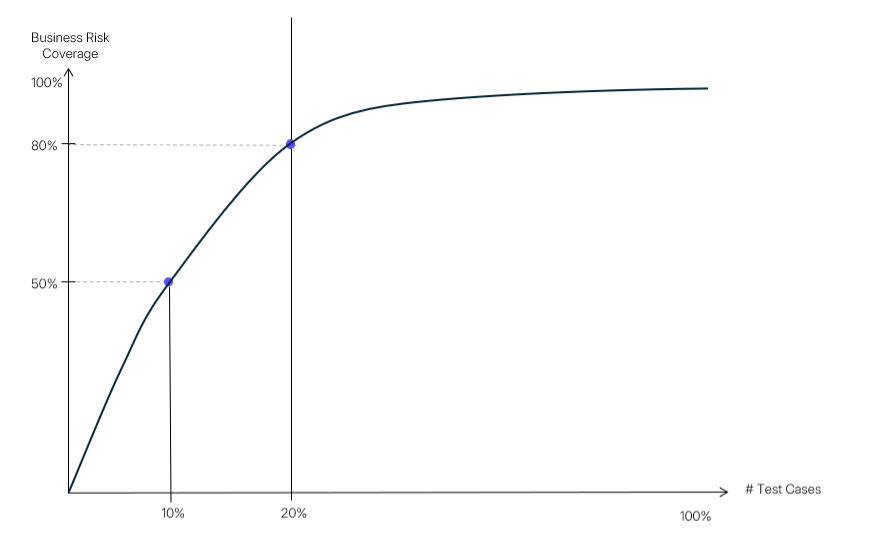
To move from 50% to around 80% risk coverage, testing needs to expand across three dimensions.
1. Use Cases (Happy Path)
This dimension verifies that the core flow works as expected. It confirms that the functionality behaves correctly when everything goes right.
2. Process Variants
This dimension covers deviations in user behavior and flow. Examples include navigating backward, retrying actions, interrupting a process, or switching context mid-flow. Many critical defects surface when users follow realistic but non-ideal paths.
3. Data Variants
This dimension focuses on how the system behaves with non-ideal data. Negative numbers, special characters, empty fields, large inputs, or concurrent users often reveal defects that happy path testing does not expose.
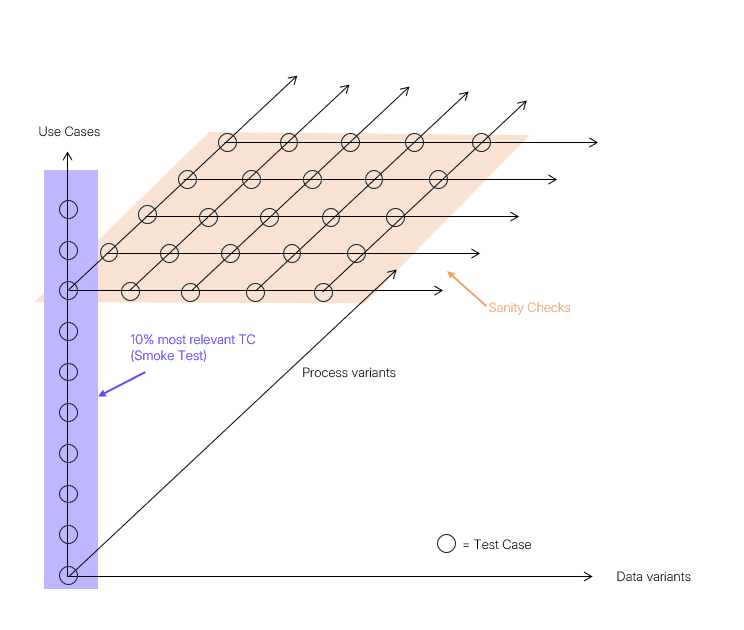
Most production issues appear in process and data variants, not in the happy path itself. These scenarios are also the first to be skipped when time or resources are limited.
Covering all three dimensions consistently requires automated software testing to keep pace with development without slowing releases. For teams that still rely heavily on manual testing, this risk-based testing approach provides a clear foundation for deciding which test cases to automate first and where automation delivers the most value.
Risk-Based Testing in Agile and Modern Development Lifecycles
Risk-based testing fits naturally into agile software development and iterative delivery models. In these environments, risk levels change continuously as the system evolves.
Common patterns include:
- Risk levels shifting sprint by sprint
- New features introducing previously unidentified risks
- Code changes increasing regression exposure in unexpected areas
Agile risk-based testing emphasizes:
- Continuous risk identification
- Regular risk evaluation
- Adaptive test planning aligned with current project risk
Rather than fixing test coverage upfront, teams continuously reassess and adjust testing priorities. This keeps the testing process aligned with real conditions in the development lifecycle and supports consistent risk monitoring across releases.
Risk-Based Testing and Test Automation: Where ROI Comes From
The World Quality Report 2025/26 reports that 54% of teams using test automation struggle to decide what to automate and when. This uncertainty leads to inefficient automation and rising maintenance costs.
Risk-based testing provides a clear framework to guide automation decisions.
Automation Priorities Based on Identified Risks
- High Frequency / High Damage
Automate immediately. These higher risk test cases should execute on every build and protect core business flows. - High Frequency / Low Damage
Apply light automation. Focus on speed and fast feedback rather than depth. - Low Frequency / High Damage
Use manual or exploratory testing. These scenarios benefit from targeted human analysis rather than constant automation. - Low Frequency / Low Damage
Exclude from testing. These test cases increase noise without contributing to risk mitigation.
This prioritization model improves automation ROI and reduces long-term maintenance burden while keeping coverage aligned with risk.
Measuring Quality: The One KPI That Matters
Traditional reporting often focuses on:
- Pass rate
- Test coverage
- Code coverage
These metrics describe activity, not safety.
Risk-based testing introduces a more relevant KPI: Business Risk Coverage.
Tracking risk coverage allows teams to understand:
- Which critical risks are covered by current test cases
- Which areas remain exposed
- Whether release decisions align with actual risk exposure
Why a Risk-Based Testing Template Makes the Difference
Risk discussions frequently lose momentum because they lack structure. A shared template introduces consistency into risk identification and risk analysis.
A structured risk based testing template:
- Creates a shared risk register
- Makes assumptions and risk ratings explicit
- Aligns business analysts, testers, and the development team
- Enables consistent risk monitoring over time
The Rapid Risk Assessment Template supports teams as they implement risk-based testing in a repeatable, scalable way.
Frequently Asked Questions
What is risk-based testing and why do teams use it?
Risk-based testing is a way to plan and run tests based on risk, not volume. Instead of trying to reach comprehensive test coverage everywhere, teams focus on identified risks, high risk areas, and the parts of the product that carry real business risks.
This approach helps software testing teams use their testing resources more effectively. Time is spent where failures would hurt most. Lower risk functionality receives less attention or lighter testing. The result is better software quality without growing the test suite endlessly.
How does risk-based testing work in agile software development?
In agile software development, risk changes constantly. New features, quick releases, and frequent changes introduce new potential risks and shift existing risk levels.
Risk-based testing in agile supports this reality. Teams regularly assess risks, discuss potential risks with business analysts and developers, and adjust testing priorities sprint by sprint. Instead of locking test coverage early, the testing process stays flexible and focused on the highest risk at that moment.
This makes risk-based testing a practical fit for modern development lifecycles, not a heavy process.
How does risk-based testing help with test automation and test coverage?
Risk-based testing gives clear direction for test automation. Rather than automating everything to increase test coverage, teams automate the test cases that protect the highest risk areas.
High-risk flows and critical paths are automated first. Lower risk areas may stay manual or receive lighter coverage. This leads to optimized test coverage, not just more tests.
Conclusion: Risk-Based Testing as a Discipline, Not an Add-On
Risk-based testing works because it forces clarity. It requires teams to name risks, rank them, and make deliberate trade-offs in how testing effort is applied. That discipline is what separates effective testing from large but ineffective test suites.
When testing focuses on identified risks rather than equal coverage, several outcomes follow consistently:
- Test cases align with real business impact
- Testing resources are spent where failures would cause damage
- Automation protects critical paths instead of inflating execution numbers
- Release decisions are based on risk exposure, not dashboard optics
Teams that apply risk-based testing stop measuring progress through volume. They measure it through risk reduction.
The Rapid Risk Assessment provides a practical way to embed this discipline into the testing process without adding complexity. It gives software testing teams, business analysts, and development teams a shared structure for risk identification, prioritizing testing, and ongoing risk monitoring.
Use the Rapid Risk Assessment Template to map your application’s risks, reassess existing test cases, and align testing effort with actual business risk.