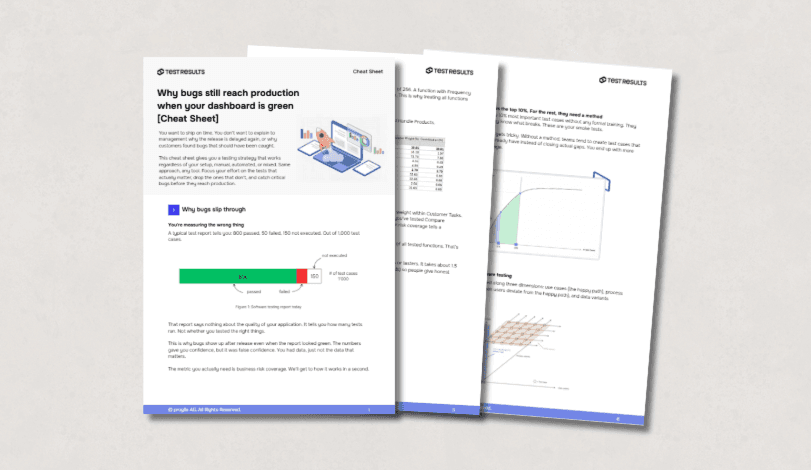
Thousands of test cases, all signed off and green, and a critical bug still reaches production.
Risk-based testing shows what your dashboard can’t: how much of your business risk is actually covered. So you know before go-live if a release is ready, and can say so with confidence.




Test counts and pass rates show that your team was busy. They don’t show whether your critical functions work.
Your experts know the main use cases by heart, so those get tested, and almost half your business risk stays uncovered.
New test cases overlap with existing ones. The suite and its maintenance keep growing, while the gaps stay where they were.

Each function is rated on its business risk, so your reports show how much of your risk is covered.
You cover the business risks that matter with a fraction of your current test cases.
When your report shows the risk it covers, nobody asks about test counts anymore, and every release decision is one you can explain.

Testing gaps are one of the most common causes of IT incidents at banks.
That’s what the Basel Committee reported in June 2026, pointing to unclear requirements and the lack of an established testing process. Risk-based testing addresses both: it shows where your requirements leave open questions and which critical functions your tests don’t cover yet.
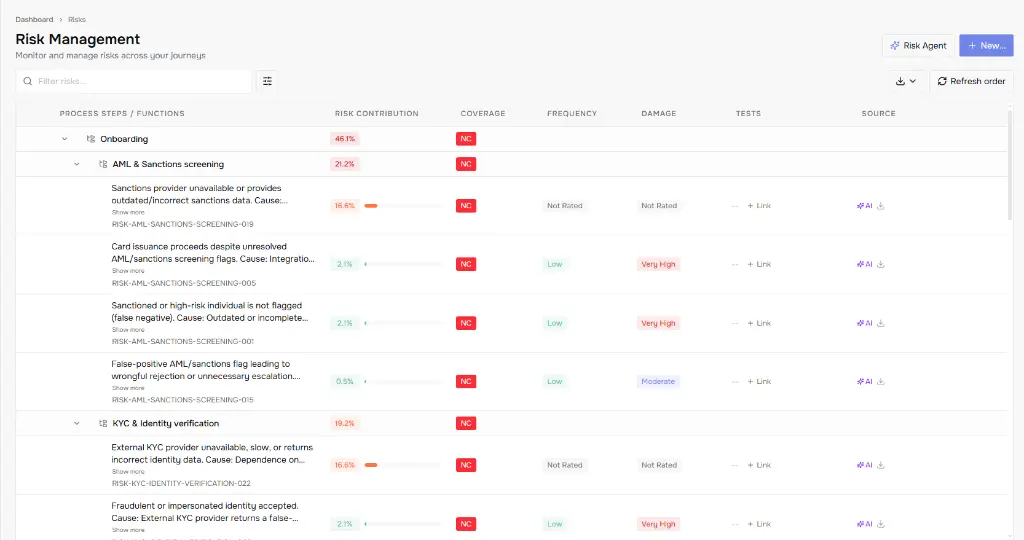
Every function of your application gets a risk score, with all risks listed in one place. Your team mitigates the ones that matter most with targeted tests.
They need a system that shows where their effort matters most
Your testers do exactly what they’re asked: test functionality and automate more. TestResults makes sure that effort goes where a failure would hurt the business most. Before you add AI or more testers, put that system in place.
Your whole testing workflow in TestResults, manual and automated, so risks, test cases and results stay linked from one release to the next.
1. ANALYZE RISKS
Business risks identified and every function rated by them. Create a free account and get your first risk analysis in minutes.
2. CLARIFY SPECIFICATIONS
Open questions and assumptions flagged where your specs leave scenarios undefined.
3. GENERATE TEST CASES
Based on your business risks, TestResults generates test cases and automates them in a few clicks.
4. TEST MANUAL OR AUTOMATED
Run your automated test cases or test manually, and catch critical bugs before your customers do.
“TestResults is user-friendly and intuitive. The onboarding sessions with the TestResults team were very valuable. The AI recognition of UI elements works very well, and we can override it manually. Their testing expertise and the continuous development of the product are remarkable.”
“We bought TestResults because it handles very complex cross-system tests and helps us automate everything we currently do by hand. What stood out was how closely we were supported during the evaluation and implementation.”
“With UFT, two or three people did the automation, and it would have taken nine months to a year. With TestResults, the whole team automates, and we did it in about three months.”
“A key requirement for us was the integration into our existing systems under strict security standards. TestResults met these requirements to our complete satisfaction.”
“TestResults is user-friendly and intuitive. The onboarding sessions with the TestResults team were very valuable. The AI recognition of UI elements works very well, and we can override it manually. Their testing expertise and the continuous development of the product are remarkable.”
Before TestResults goes live, your security and infrastructure teams have to approve it. It meets the security standards of Tier-1 banks, and we do the setup together with your teams.

TestResults runs fully on-premises or in your private cloud, with a local deep learning model for element recognition and the option of connecting it to your own on-prem LLM.

Run TestResults entirely on your internal network. Screens and test data are not used to train our AI model.

DORA, FINMA, BAIT, SOX, COBIT, ITIL, ISO. Every test run is logged with timestamps and documented automatically. Compliant reports out of the box, no manual evidence gathering.
Answers to the questions probably running through your mind right now
TestResults analyzes your specifications for each release, and your team only reviews the results and answers open questions. You see your first business risk coverage within about 20 minutes, depending on the size of the documents.
Doing the same manually, from rating the risks to mapping your test cases, usually takes around two weeks.
You can use them to summarize specifications, and many teams do. For risk-based testing they fall short: each prompt rates risks a little differently, so results change from one release to the next and are hard to trace in an audit. TestResults rates risk with one consistent method, keeps risks, test cases and results linked across releases, and shows your business risk coverage before every go-live.
Risk-based testing prioritizes test cases by business risk: how often a function is used and how much damage a failure causes. A payment transfer gets more attention than a rarely used settings page, and your reports show how much of that risk is covered.
Many banks already rate risks as low, medium or high, or with operational risk scores. For testing, those ratings are too coarse: when most functions end up as “high”, they don’t show what to test first, and they can’t be added up to a coverage figure.
Not every function in an application is equally important. A login that thousands of people use every day matters more than a settings page that hardly anyone opens. Business risk coverage gives each function a weight, based on how often it’s used and how much damage a failure would cause. Then it adds up the weights of everything you tested. The result shows what share of the real business risk your tests cover, which is a better basis for a release decision than the number of passed tests.
Test coverage counts how many functions you tested and treats them all as equally important. A payment transfer and a rarely used settings page get the same weight, so a high coverage number can hide untested critical functions.
Business risk coverage weights each function by how often it’s used and how much damage a failure would cause. It shows how much of the risk that matters to your bank is actually covered.
TestResults analyzes your specifications or user stories for each release and rates the business risk of every function. Where something isn’t defined in your files, it flags open questions for your team to answer, and your team adjusts the ratings where needed.
Yes. The method works with manual, automated or mixed testing. Many teams start by mapping their existing test cases to business risk and see right away where the gaps are.
Yes. DORA asks banks to manage their ICT risk, including testing. Risk-based testing gives you a documented link between your business risks and the tests run before every release.
When your business risk coverage reaches your target, usually 80% or more. Up to that point, each new test case adds noticeable coverage. After that, the curve flattens: more tests add maintenance, but hardly any coverage. That’s the point where you can make a confident go/no-go decision.
Yes. TestResults has built-in integrations with tools like Jira with Xray and Azure DevOps, so you can import your existing test cases and map them to your risks right away.